
Sliding, Swing or Telescopic: Which Automatic Door Is Right for Your Building?
There are several types of automatic doors, but for most commercial buildings the choice comes down to three: sliding, swing and telescopic. Each suits different spaces, footfall levels and budgets, and picking the wrong one can mean a cramped entrance, a door that wears out early, or an opening that is harder for disabled visitors to use.
This guide explains how each door type works, where it fits best, and what to think about around activation, escape routes, glazing and maintenance. It also covers the less common types of automatic doors, such as revolving and curved sliding doors, so you know what is out there.
- Sliding doors suit busy entrances with room for the leaves to slide to the side.
- Telescopic doors give a wider opening where side space is limited.
- Swing doors suit narrower openings, internal doors and retrofits, and come in full-energy and low-energy versions.
- Any powered door on an escape route needs to be designed and set up for that job.
- Euro Automatic Doors mainly supplies and fits sliding, swing and telescopic doors, and repairs all major makes.
The 3 main types of automatic doors
1. Automatic sliding doors
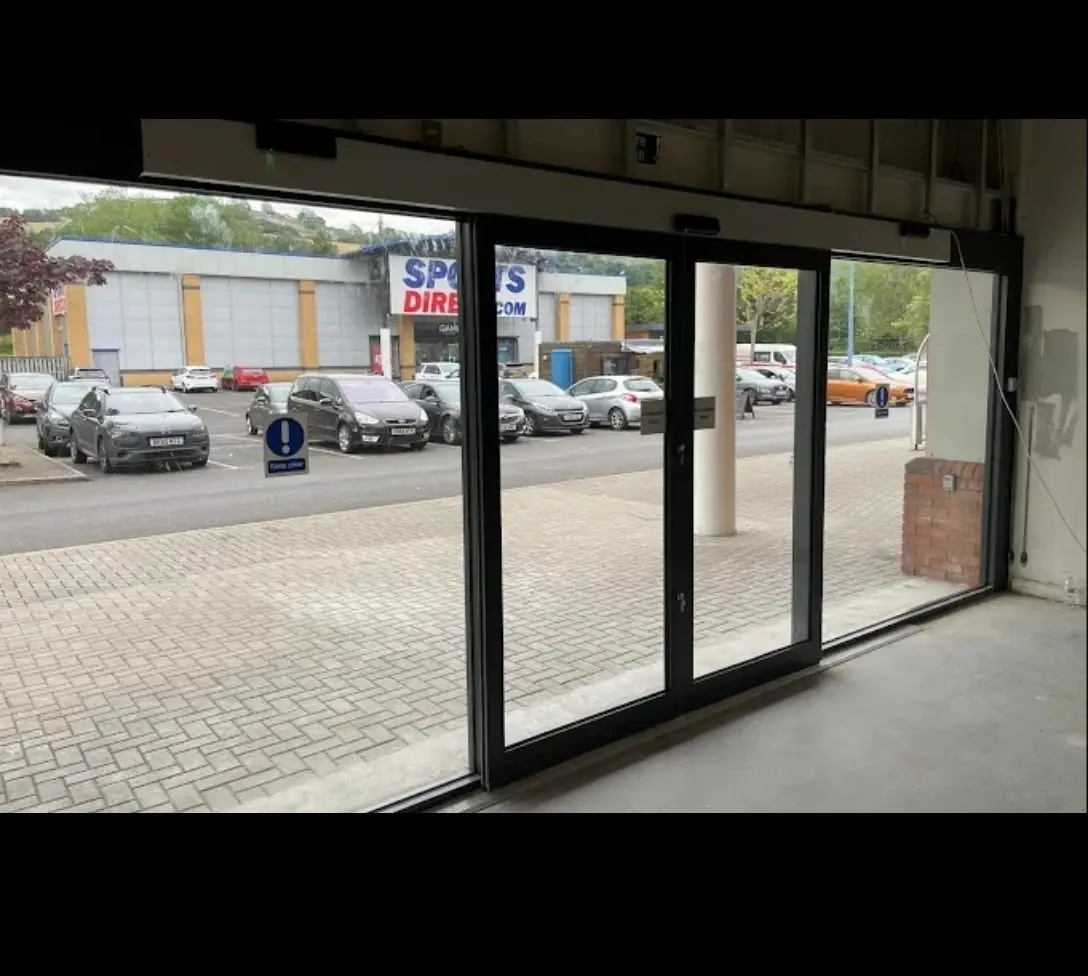
Automatic sliding doors are the most familiar sight at supermarkets, retail parks, hospitals and office receptions. An operator above the opening drives one or more leaves sideways along a track, guided at floor level.
- Single sliding: one leaf slides to one side. Useful where there is wall space on one side only.
- Bi-parting: two leaves slide apart from the centre. This is the most common arrangement for main entrances, because the doors open quickly and evenly.
Sliding doors don’t swing into the walkway, so people aren’t at risk of being struck by a door opening towards them. The government’s Approved Document M, Volume 2 (England) notes that an automatic sliding door arrangement is particularly beneficial because it avoids the risks associated with automatic swing doors. The trade-off is space: you need clear wall either side of the opening for the leaves to park in.
Our own ASK-2-E sliding door operator is in service in many buildings, including airports.
2. Automatic telescopic doors
Automatic telescopic doors are a variation on sliding doors. Instead of one leaf per side, each side has two (or more) leaves that slide at different speeds and stack behind each other when open. That gives a wider clear opening for the same width of wall.
RECORD, for example, describes its telescopic doors as needing up to 30% less wall space than conventional sliding doors. They are a good answer where you want a wide entrance for wheelchairs, beds, trolleys or crowds, but the building doesn’t have much side space. Telescopic operators carry more moving parts, so they are typically more complex than a standard slider.
3. Automatic swing doors
Automatic swing doors work like a normal hinged door, with an operator on the head that opens and closes the leaf. They come as single or double (pairs of leaves), and suit narrower openings, internal corridors, toilets, offices and doors where there is no room for sliding leaves.
There are two broad approaches:
- Full-energy: the door opens and closes at normal speed, triggered by sensors or a switch. Because a swinging leaf can strike someone, full-energy swing doors rely on safety sensors and careful risk assessment.
- Low-energy: the door moves more slowly and with limited force. It is often used on doors opened by push pad, such as accessible toilets and internal doors with lighter traffic. Depending on the risk assessment, a low-energy door may need fewer safety devices, but it still has to be assessed and set up correctly.
Approved Document M says that where swing doors open towards people approaching them, visual and audible warnings should be provided for their automatic operation when both opening and shutting.
Other types of automatic doors
We mainly supply and fit sliding, swing and telescopic doors. You may also come across these other types of automatic doors:
- Curved sliding doors: leaves run on a curved track to form a semicircular or circular entrance. They look striking and can help create a lobby, but they are a specialist, higher-cost product.
- Revolving doors: leaves rotate around a central axis, which helps reduce draughts at busy entrances. Approved Document M states that revolving doors are not considered accessible, and that where one is used, an accessible entrance door should be provided immediately next to it.
- Folding doors: leaves fold back as they open, useful where neither sliding nor swing doors fit. Approved Document M includes folding action alongside sliding and swinging in its guidance on powered entrance doors.
- Balanced doors: a type of pivoting door that needs less space to open than a standard swing door. They are usually manual but can be powered.
Types of automatic doors compared
This table gives a general comparison. Every site is different, so treat it as a starting point rather than a specification.
| Factor | Sliding | Telescopic | Swing |
|---|---|---|---|
| Space needed | Clear wall either side for the leaves | Less side wall than a standard slider for the same opening | Swing space in front of or behind the door |
| Clear opening | Good; bi-parting gives a wide central opening | Widest for the available wall space | Limited by leaf width and hinge side |
| Footfall | High; ideal for main entrances | High | Low to medium (full-energy can handle more) |
| Typical uses | Retail, supermarkets, hospitals, offices, transport | Hospitals, care homes, shops and entrances with tight side space | Internal corridors, toilets, offices, schools, retrofits |
| Accessibility | Very good; no leaf swings into the path | Very good, with a wide opening | Good, with suitable warnings and timing |
| Security | Can be locked with suitable locking | Can be locked with suitable locking | Can work with standard locks and access control |
| Escape routes | Breakout leaves or fail-safe open set-ups available | Breakout options vary by product | Can be suitable, depending on the set-up |
How to choose between the types of automatic doors
Ask yourself these questions before you get quotes:
- How much space is there? Measure the wall either side of the opening and the floor area in front of and behind it.
- How many people use it? A busy supermarket entrance and a quiet office corridor need very different doors.
- Who uses it? Think about wheelchair users, people with prams, older visitors, patients on beds and anyone who cannot react quickly.
- Is it on an escape route? If so, the door must be designed and configured for that.
- Does it need to be secure out of hours? Consider locking, access control and how the door behaves on power loss.
- Is it a new build or an existing door? New openings give more choice; existing doors may suit a retrofit operator.
- How exposed is it? Wind, weather and heat loss all affect the right choice.
Our guide on how to specify automatic sliding doors goes into more detail, and you can see the sectors we work in for examples.
Activation methods for all types of automatic doors
Every door needs something to tell it when to open. Approved Document M lists both manual and automatic methods for powered entrance doors, including push pads, card swipe, coded entry and remote control, as well as motion or other proximity sensors. Common options are:
- Motion sensors: the usual choice for busy entrances. They detect people approaching and open the door hands-free.
- Push pads: common on low-energy swing doors, giving the user control. Approved Document M says manual controls should stand out clearly from their background and be placed so the user doesn’t have to move out of the way as the door opens.
- Access control: card readers, keypads, fobs and intercoms restrict entry to authorised people.
- Touchless switches: wave-to-open sensors offer hygienic activation without the door opening for every passer-by.
Whatever the method, sensors should be set so the door opens early enough and stays open long enough for safe entry and exit.
Escape routes and breakout
Whichever of the types of automatic doors you choose, if it is on an escape route it must be readily usable in an emergency. Approved Document M says powered entrance doors should revert to manual control or fail safe in the open position if the power fails. The Workplace Regulations 1992, regulation 18, also require powered doors to be capable of manual operation where needed for safety, unless they open automatically if the power fails.
In practice, sliding and telescopic doors on escape routes often use breakout leaves (which can be pushed open in the direction of escape) or an arrangement that opens the door on power failure or fire alarm. The right approach depends on the building’s fire strategy, so involve your fire risk assessor and building control early. This is general information, not legal advice.
Materials, glazing and thermal performance
Most types of automatic doors use aluminium frames with glazed leaves, or frameless glass. Under the Workplace Regulations, transparent or translucent doors must be made of safety material or protected against breakage, and must be marked or otherwise made apparent where needed for safety.
For exposed entrances, consider thermally broken frames, double glazing, good seals and a lobby with two sets of doors to reduce heat loss and draughts. Several manufacturers offer thermally insulated sliding and telescopic systems.
Maintenance differences between door types
All types of automatic doors need regular servicing, but the workload differs:
- Sliding doors need attention to rollers, belts, floor guides and sensors. Floor guides collect grit, especially at busy external doors.
- Telescopic doors have more leaves and moving parts, so there is more to inspect and adjust.
- Swing doors put load on hinges and arms, so these and the leaf alignment need checking, along with any safety sensors.
See our guides on how often automatic doors should be serviced and maintenance contracts, or our automatic door maintenance service. If a door has already failed, our automatic door not working guide explains what to check.
Retrofitting an operator to an existing door
You don’t always need a whole new door, whatever the types of automatic doors elsewhere in your building. Many existing manual swing doors can be automated by fitting an operator, which is a popular way to improve accessibility. The door, frame and hinges must be in good condition, and the finished door needs a risk assessment and the right safety features. Our automatic door upgrades page explains what is involved, and our accessibility guide and BS EN 16005 guide cover the wider requirements.
For new openings, see commercial automatic door installation and new build automatic doors. We install across southern England, the Midlands and the North West; see areas we cover. New installations come with a 2-year manufacturer’s warranty, extended to 3 years with a maintenance contract.
Types of automatic doors: frequently asked questions
What are the main types of automatic doors?
The main types are sliding (single or bi-parting), telescopic and swing (single or double, full-energy or low-energy). Less common types include curved sliding, revolving, folding and balanced doors.
Which type of automatic door is best for a busy entrance?
Bi-parting sliding doors are the usual choice for busy entrances because they open quickly and nothing swings into the walkway. Where side space is limited, telescopic doors give a wider opening in less wall space.
What is the difference between full-energy and low-energy swing doors?
Full-energy swing doors open and close at normal speed and rely on safety sensors. Low-energy swing doors move more slowly with limited force and are often activated by push pad, for example on accessible toilets and internal doors.
Are revolving doors accessible?
Approved Document M states that revolving doors are not considered accessible. Where one is used, an accessible entrance door should be provided immediately next to it.
Can I add an automatic operator to my existing door?
Often, yes. Many manual swing doors can be fitted with an operator, as long as the door, frame and hinges are in good condition. The finished door needs a risk assessment and the right safety features.
Which types of automatic doors does Euro Automatic Doors install?
We mainly supply and fit automatic sliding, swing and telescopic doors, and we repair and maintain all major makes.