
Automatic Doors and Accessibility: What the Equality Act 2010 Means for Your Building
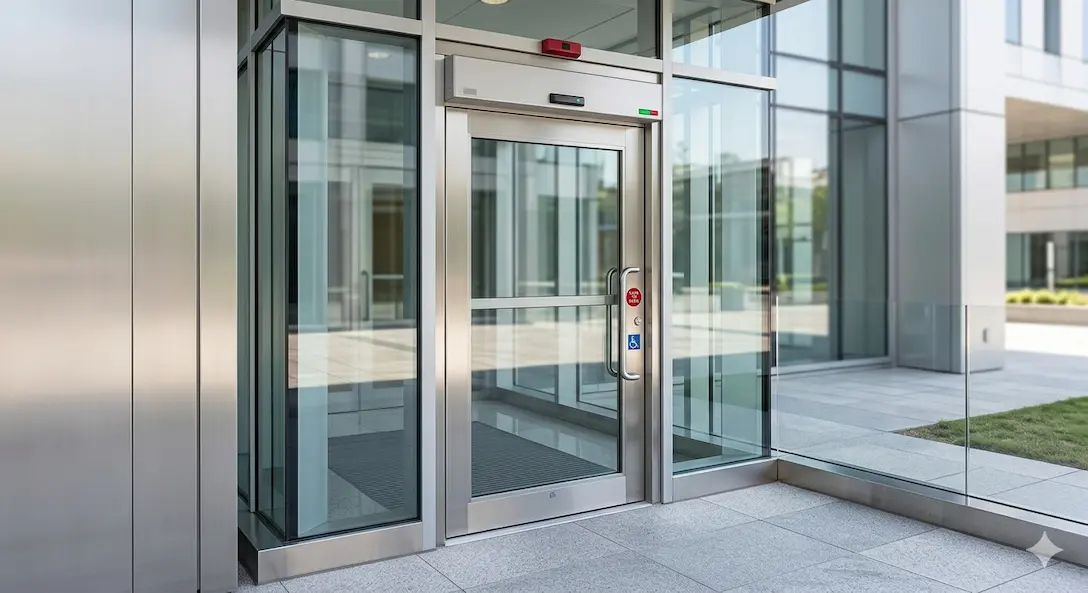
Automatic doors accessibility is about more than fitting a motor to a door. A well-specified powered entrance lets wheelchair users, people with limited strength or grip, people using walking aids, parents with buggies and visually impaired visitors get in and out without help. A badly set-up one can be just as much of a barrier as a heavy manual door.
This guide explains what the Equality Act 2010 expects of service providers and employers, how building guidance in England treats entrance doors, and the practical features that make the biggest difference to automatic doors accessibility in real buildings.
- Under the Equality Act 2010, service providers and employers must make reasonable adjustments, including to physical features such as doors.
- For services, the duty is anticipatory: you should plan for disabled people’s needs, including automatic doors accessibility, before anyone asks.
- Approved Document M describes a powered door as the most satisfactory solution for most people at an entrance, and sets out what powered entrance doors should do.
- Good automatic doors accessibility depends on clear width, reachable controls, sensible timing, safe detection, visibility, a level threshold and signage.
- A broken or badly adjusted automatic door is no longer an accessible door, so maintenance matters.
What the Equality Act 2010 requires
The duty to make reasonable adjustments
Section 20 of the Equality Act 2010 sets out a duty to make reasonable adjustments. One of its three requirements covers physical features: where a physical feature puts a disabled person at a substantial disadvantage compared with people who are not disabled, the duty-holder must take reasonable steps to avoid that disadvantage. The Act says this can include removing the feature, altering it or providing a reasonable means of avoiding it.
“Physical feature” is defined widely. It includes features arising from the design or construction of a building, features of the approach to, exit from or access to a building, and fixtures, fittings and equipment. Entrance doors fall squarely within that. The Act also says the duty-holder cannot ask the disabled person to pay for the adjustment, unless the Act expressly provides otherwise.
Service providers: an anticipatory duty
Section 29 applies the duty to anyone providing services to the public, and to those exercising public functions. The official explanatory notes to Schedule 2 say the duty is owed to disabled people generally, so it is anticipatory. In plain terms, shops, offices open to visitors, surgeries, hotels and public buildings should think ahead about access, including automatic doors accessibility at their entrances, rather than waiting for a complaint. The same notes give the example of a shop chain installing a ramp, automatic doors and hearing loops.
Employers
Section 39 applies the duty to employers for their staff and job applicants. Here the duty generally arises once the employer knows, or could reasonably be expected to know, that a worker is disabled. The Equality and Human Rights Commission’s guidance uses a door example: clear glass doors at the end of a corridor can be a hazard for a visually impaired worker, and adding markings to make them more visible is likely to be a reasonable adjustment. The same thinking applies to automatic doors accessibility on staff entrances and internal routes.
What counts as “reasonable”?
The Act does not give a fixed list of adjustments. Whether a step is reasonable depends on the circumstances, including how much it would help and what it would cost in time and money. For many buildings, an automatic door at the main entrance is one of the most effective changes available, and a sensible starting point for any automatic doors accessibility review.
Building guidance for entrance doors
Approved Document M (England)
In England, Approved Document M, Volume 2 (buildings other than dwellings) gives statutory guidance on access to and use of buildings. It applies when building work is done: new buildings, extensions, material alterations and certain changes of use. It does not, on its own, require an existing building to be upgraded. Even so, it is a useful benchmark when you are planning an upgrade. The current version on gov.uk is the 2015 edition incorporating the 2020 and 2024 amendments.
Approved Document M also makes clear that following it does not necessarily mean you have met your Equality Act duties, which can go further. Points from the entrance doors section worth knowing for automatic doors accessibility:
- A powered door, controlled manually or by sensor, is described as the most satisfactory solution for most people, and automatic sliding doors are noted as particularly beneficial (paragraph 2.10).
- Where a manual door would need more opening force than people can manage, it should be powered. The guide figure for manual doors is not more than 30N at the leading edge from 0 to 30 degrees open, and not more than 22.5N from 30 to 60 degrees.
- Table 2 sets minimum effective clear widths. For external doors to buildings used by the general public, the figure is 1000mm in new buildings and 775mm in existing buildings.
- Paragraph 2.21 lists what powered entrance doors should do, including opening early enough and staying open long enough, a safety stop if the doors begin to close on someone, and reverting to manual or failing open on power failure.
- Manual controls for powered doors should be 750mm to 1000mm above floor level and operable with a closed fist.
- Revolving doors are not considered accessible, so an accessible door should be provided alongside.
BS 8300
BS 8300 is the British Standard code of practice for designing an accessible and inclusive built environment. Part 2 covers buildings, and BSI lists BS 8300-2:2018 as current. It goes into more detail than Approved Document M and is widely used by architects and access consultants, including when planning automatic doors accessibility at entrances. As a code of practice, it gives recommendations rather than legal requirements.
Scotland
Scotland has its own system. Accessible entrances and powered doors are covered by the Building Standards Technical Handbooks, published by the Scottish Government. The approach is similar in spirit to England’s but the detail and figures differ, so check the current non-domestic handbook rather than relying on Approved Document M.
Automatic doors accessibility: 8 essential features
Whatever type of door you choose, these are the features that decide whether it works for disabled people in practice. Use them as an automatic doors accessibility checklist when you specify, upgrade or service a door.
1. Enough clear width
The effective clear width is the space a person can actually pass through, not the size of the frame. Ironmongery and leaves that do not open fully reduce it. Telescopic sliding doors can give a wider opening where the side space is limited.
2. Controls people can reach and use
Where a door is opened by a push pad, card reader or keypad, the control needs to be within reach of a seated person, usable with a closed fist and visually contrasting with its background. On the opening side of a swing door, it should be set back far enough that the user is not hit by the leaf.
3. Sensible opening and hold-open times
The door should start opening early enough and stay open long enough for slower users. A door that closes too quickly is one of the most common automatic doors accessibility complaints, and usually a settings issue rather than a fault.
4. Safe detection while people pass through
Presence detection should keep the door open, or stop it, while someone is in the opening. This matters most for people who move slowly or stop in the doorway. BS EN 16005 covers the safety in use of power-operated pedestrian doors. See our BS EN 16005 guide.
5. Visibility and glazing manifestation
Glass doors and screens need markings so people can see them. Approved Document M points to Approved Document K for manifestation. The door should also be easy to tell apart from any glazed screen around it.
6. A level threshold and clear landing
A level threshold is preferred. Where a raised threshold cannot be avoided, Approved Document M says its total height should be no more than 15mm. A level landing in front of the entrance, clear of door swings, also helps wheelchair users.
7. Safe behaviour on power failure
Powered entrance doors should revert to manual or fail open when the power goes. Doors on escape routes need particular care, so check this with your installer and fire risk assessor.
8. Signage and warnings
Clear signs help people understand how a door works and which way it moves. Where swing doors open towards people, Approved Document M calls for visual and audible warnings when they open and close.
Low-energy swing doors for internal routes
Automatic doors accessibility is not just about the front entrance. Corridor doors, toilet lobbies, meeting rooms and fire doors on internal routes can be just as hard to open. Low-energy swing door operators move the door more slowly and with lower force, which can reduce the safeguarding needed while still opening the door at the push of a button. They are often a practical way to improve automatic doors accessibility throughout a building. See our automatic swing doors page for options.
Retrofitting operators to existing doors
You do not always need a new door to improve automatic doors accessibility. An operator can often be fitted to an existing manual swing door, or an old automatic door can be upgraded with new drive units, sensors and controls. Points to check:
- The door, frame and hinges must be in good condition and strong enough for the operator.
- Fire doors need care, as any change must not affect fire performance.
- HSE guidance (L24) notes that new powered doors, including manual doors fitted with powered actuators, must meet the Supply of Machinery (Safety) Regulations 2008 before first use.
- A safety risk assessment should be carried out for the finished installation.
Our automatic door upgrades service covers retrofits on most makes. For new entrances, see commercial automatic door installation, new-build automatic doors and our guide on how to specify automatic sliding doors.
Maintenance and automatic doors accessibility
An automatic door that is out of order, locked in manual mode or closing too fast is not accessible. Planned servicing keeps sensors, timings and safety devices set correctly, which is central to good automatic doors accessibility. In workplaces there is also a separate legal duty to maintain powered doors.
Our guides on how often automatic doors should be serviced and automatic door maintenance contracts explain the options. Euro Automatic Doors offers maintenance plans and repairs on any make, including RECORD, GEZE, dormakaba, TORMAX, ASSA ABLOY (Besam) and HORTON, with a 24/7 emergency call-out across England and Scotland.
Automatic doors accessibility questions
Does the Equality Act require automatic doors?
No. The Act does not name specific products. It requires service providers and employers to make reasonable adjustments, including to physical features. For many buildings, an automatic door at the entrance is one of the most effective adjustments, and the official explanatory notes give automatic doors as an example.
Do I have to wait until a disabled customer asks?
Not if you provide services to the public. That duty is anticipatory, so you should plan ahead for disabled people’s needs. For employers, the duty generally arises once you know, or could reasonably be expected to know, that a worker is disabled.
What clear width should an accessible entrance door have?
In England, Approved Document M gives a minimum effective clear width of 1000mm for external doors to buildings used by the general public in new buildings, and 775mm in existing buildings. Other figures apply to other doors, and Scotland has its own guidance.
Can an automatic opener be fitted to my existing door?
Often, yes, if the door and frame are in good condition. A retrofitted powered door must be safe and correctly assessed, and fire doors need extra care. A specialist can survey the door and advise.
Are revolving doors accessible?
Approved Document M says revolving doors are not considered accessible. Where one is used, an accessible door should be provided immediately next to it and clearly signed.
How does maintenance affect automatic doors accessibility?
A door that is broken, slow to open or closing too quickly can stop disabled people getting in. Regular servicing keeps sensors, timings and safety devices working as intended.