

How Often Should Automatic Doors Be Serviced?
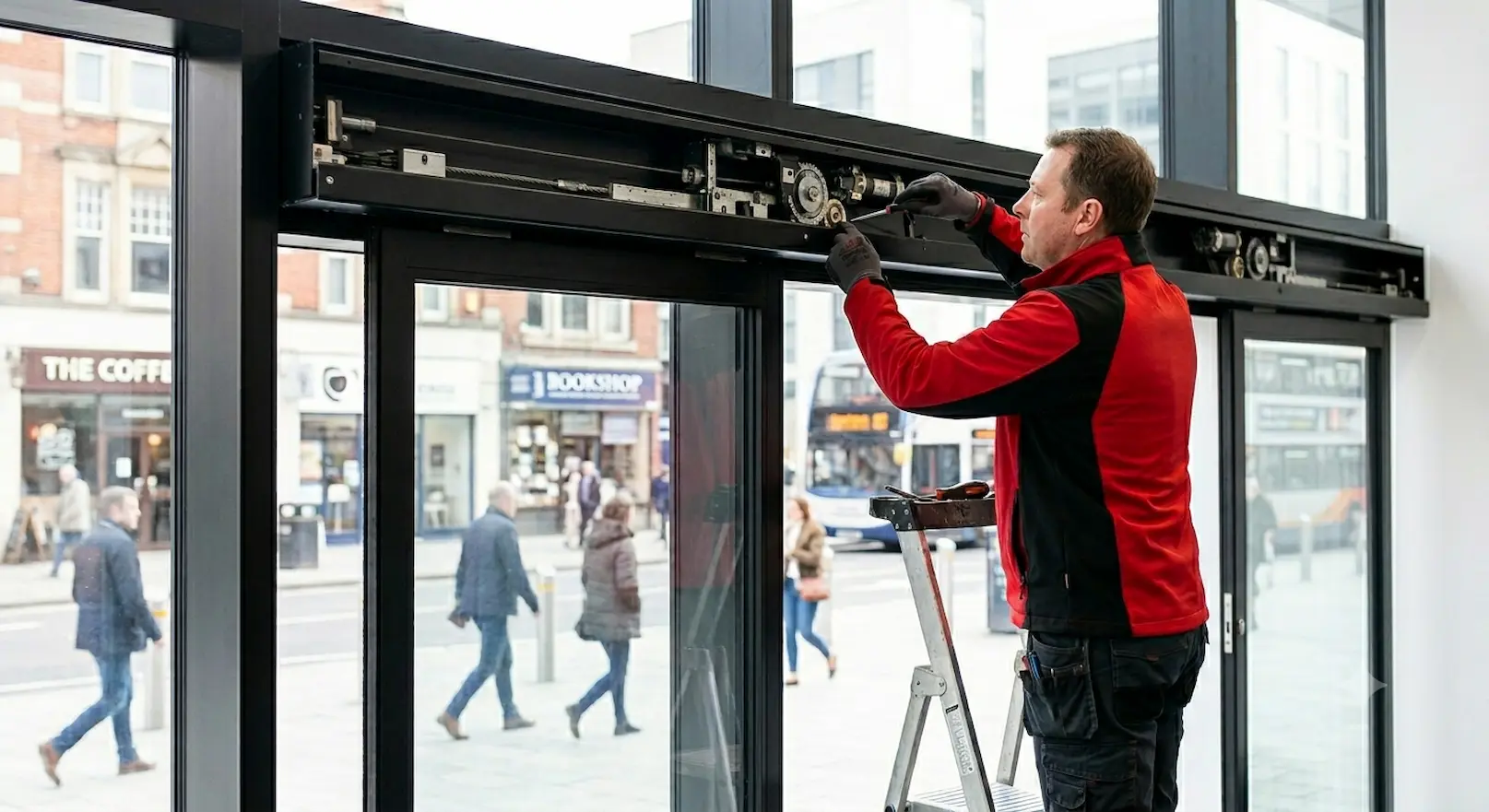
Automatic door servicing should happen at least once a year for almost every commercial door, and more often for busy entrances, harsh environments or doors used by vulnerable people. That is the short answer. The right frequency for your doors depends on how hard they work, where they are and what the manufacturer recommends.
Regular automatic door servicing keeps doors safe for the people walking through them, cuts down on breakdowns and gives you the records you need to show the doors are being looked after. This guide explains how often automatic doors typically need servicing, what a proper service should include, where the law comes in, and how a planned maintenance plan works in practice.
- Once a year is the baseline. Many manufacturers recommend more frequent maintenance, and busy doors usually need two to four visits a year.
- Footfall, environment, door type and age, the people using the door and the manufacturer’s instructions all affect frequency.
- A proper service tests every safety function, not just the motor.
- The Workplace Regulations 1992 require doors and their safety devices to be maintained, and BS EN 16005 expects regular, documented maintenance.
- Skipping servicing tends to lead to more breakdowns, higher repair bills and greater safety risk.
The short answer: how often is automatic door servicing needed?
As a baseline, plan for at least one service a year. This is what the major manufacturers state. dormakaba, for example, advises that power operated pedestrian doors should be maintained at least once a year, depending on usage and traffic, and Boon Edam also states that EN 16005 doors need maintenance at least once a year, documented in writing.
Some manufacturers go further. The installation manual for a RECORD sliding door operator, for instance, gives a testing frequency of at least once a year and a maintenance frequency of at least twice a year. Always check the instructions for your own operator, because the manufacturer’s recommendation is the minimum your engineer should work to.
Once a year is a floor, not a target. A door at a busy supermarket entrance may open and close thousands of times a day, and it will wear far faster than a door to a quiet staff corridor.
Typical automatic door servicing frequency by setting
The table below is general guidance based on how doors are typically used. It is not a rule. Your manufacturer’s instructions and a risk assessment of your actual doors should always come first.
| Setting and footfall | Examples | Typical frequency |
|---|---|---|
| Low use | Staff entrances, small offices, internal doors with light traffic | Once a year (minimum) |
| Moderate use | Busy offices, schools, GP surgeries, care homes, hotels | Twice a year |
| High use | Supermarkets, retail units, shopping centres, hospital main entrances | Four times a year |
| Very high use or demanding conditions | Airports, stations, 24-hour sites, exposed or dusty entrances | Four times a year or more, based on risk assessment |
If your door serves vulnerable users, such as older people, children or patients, consider moving up a band even if traffic is moderate. Whichever band you choose, note in your records why that level of automatic door servicing suits the door. If an engineer keeps finding worn parts or faults on each visit, that is a sign the interval is too long.
Factors that affect how often you need a service
No two sites are the same, so the right automatic door servicing schedule comes down to a handful of practical factors.
Footfall and cycles
Every opening cycle wears the motor, gearbox, belts, rollers, tracks and sensors. The more cycles, the sooner parts need adjusting or replacing.
Environment
External doors facing the weather, doors near loading bays, and doors in dusty, damp, salty or busy trolley areas suffer more. Grit in the floor track of a sliding door, for example, increases wear and can stop leaves running smoothly.
Door type and age
Sliding, swing and telescopic doors each have different wear points. Telescopic and revolving doors have more moving parts to check. Older doors usually need more attention, and parts can become harder to source.
Who uses the door
Hospitals, care homes, schools and public buildings have more users who could be hurt if a safety device fails. A higher service frequency reduces the time a fault could go unnoticed.
Manufacturer recommendations
The manufacturer’s maintenance instructions set the minimum. Your installer should have handed these over with the door. If you do not have them, a competent engineer can advise.
What a proper automatic door servicing visit includes
Automatic door servicing is more than a quick look and a squirt of lubricant. A thorough visit should cover these 10 essential checks:
- Checking the activation sensors open the door reliably and at the right distance.
- Testing the safety sensors stop or reverse the door when someone is in its path.
- Checking opening and closing speeds and forces against the commissioned settings.
- Inspecting the operator: motor, gearbox, belts, pulleys, control unit and wiring.
- Checking leaves, rollers, carriages, tracks, floor guides, pivots and hinges for wear and alignment.
- Testing emergency functions: battery backup, break-out, fail-safe opening on power loss and fire alarm interface where fitted.
- Testing locks, mode switches and access control connections.
- Checking guards, covers, finger protection and screens are present and secure.
- Checking signage and glass manifestation are present and visible.
- Cleaning, adjusting and lubricating where needed, then completing a written report and updating the log book.
The written report should list what was checked, what was found, anything fixed, and anything recommended for later. Keep it with the door’s log book.
Automatic door servicing and the law
Regulation 5 of the Workplace (Health, Safety and Welfare) Regulations 1992 requires the workplace and its equipment and devices to be maintained in an efficient state, in efficient working order and in good repair, with a suitable system of maintenance where appropriate. That includes devices whose failure could breach the regulations, and devices meant to prevent or reduce hazards. The safety sensors and emergency functions on an automatic door fit both descriptions.
Regulation 18 adds that powered doors must have effective features to prevent them trapping anyone. A sensor that has drifted out of adjustment no longer does that job, which is why servicing matters.
BS EN 16005, the standard for the safety in use of power operated pedestrian doors, expects safety functions to be maintained and the work recorded in the door’s log book. The law does not set a fixed number of visits. The frequency should be based on the manufacturer’s instructions and the risk, and you should be able to show it is suitable.
Industry guidance also suggests simple owner checks between services. CIBSE guidance, for example, suggests the occupier carries out a weekly safety check. That means watching the door work, checking it stops for people, looking for damage and reporting anything odd. It complements professional automatic door servicing but does not replace it.
The cost of skipping automatic door servicing
Putting off a service can look like a saving. In practice it usually costs more:
- More breakdowns: small issues such as worn rollers, slipping belts or dirty sensors get worse until the door fails, often at a bad time.
- Bigger repairs: a worn part left too long can damage others, turning a minor adjustment into a motor or gearbox replacement.
- Safety risk: safety sensors can fail or drift without anyone noticing. A door that closes on someone can cause serious injury.
- Legal exposure: without service records, it is harder to show you met your maintenance duties if something goes wrong.
- Lost trade and access problems: a shop door stuck shut costs customers, and a door stuck open affects security and heating.
- Warranty issues: many warranties depend on regular, documented maintenance.
Signs your door needs a service now
Do not wait for the next scheduled visit if you notice:
- Grinding, squealing, banging or clunking noises.
- The door opening slowly, hesitating, juddering or stopping part way.
- Opening late or not at all as people approach, or opening when nobody is there.
- Closing on people, or not stopping or reversing when it should.
- Leaves dragging, jumping off the track or not meeting properly.
- Error lights or codes on the control unit or mode switch.
- Visible damage, loose covers or missing guards.
Many of these faults are cheap to fix early and expensive to fix late, so report them straight away rather than waiting for the next round of automatic door servicing. If the door could hurt someone, switch it off, secure it and call for help. Our 24/7 emergency call-out covers England and Scotland. For simple fault-finding, see automatic door not working.
How a planned maintenance plan works
The simplest way to keep on top of automatic door servicing is a planned maintenance plan. You agree the number of visits up front and your engineer schedules them, so services are not forgotten. Our automatic door maintenance plans offer:
- One visit a year: suited to low-use doors.
- Two visits a year: suited to moderate use.
- Four visits a year: suited to busy or high-risk entrances.
Not sure which level to pick? Start from the frequency table above, then adjust for your environment and users. Your engineer can review the plan after the first year of automatic door servicing, once they have seen how the doors are wearing.
Every visit includes a full service and safety check with a written report for your records. Our higher plans also include reactive call-outs and discounts on parts. To compare options, read our guide to choosing an automatic door maintenance contract.
Euro Automatic Doors has more than 25 years in automatic doors and 22 directly employed engineers, not subcontractors. We service all major makes, including RECORD, GEZE, dormakaba, TORMAX, ASSA ABLOY and HORTON, as well as doors another company installed and our own ASK-2-E sliding door operator.
Automatic door servicing: common questions
Is annual automatic door servicing a legal requirement?
The law does not set a fixed number of visits. It requires doors and their safety devices to be properly maintained. Manufacturers generally recommend at least one service a year, so annual servicing is the minimum most owners should plan for.
How long does an automatic door service take?
It depends on the door type, its condition and how many doors are on site. A single straightforward door takes far less time than a revolving door or a site with many entrances. Your engineer can give you a better idea for your site.
Can my own staff service our automatic doors?
Staff can carry out simple visual and functional checks between visits. Servicing, adjustment and safety testing should be done by a trained automatic door engineer, because untrained adjustments can disable safety functions.
Do you service doors installed by another company?
Yes. We service and repair most makes of automatic door, including RECORD, GEZE, dormakaba, TORMAX, ASSA ABLOY and HORTON, whoever installed them.
Does automatic door servicing affect my warranty?
It can. Many warranties depend on the door being maintained in line with the manufacturer’s instructions. On new installations by Euro Automatic Doors, the 2-year manufacturer’s warranty is extended to 3 years with a maintenance contract.
What records should I keep after a service?
Keep the engineer’s written report and make sure the door’s log book is updated with the date, the work done and any recommendations. Keep repair and incident records in the same place.
Not sure which plan suits your doors? Get in touch and we will recommend a frequency based on your doors and how they are used.